Id Do It Over Again I Watch It Blow in the Wind
NCERT Solutions for Class 9 English language Poem Chapter 2 Air current are function of NCERT Solutions for Class 9 English language. Hither we accept given CBSE Form 9 English Poem Affiliate 2 Wind.
NCERT Solutions for Class nine English Poem Affiliate 2 Wind
NCERT Textbook Questions
Thinking about the poem
(Page 31)
I.
Question 1.
What are the things the wind does in the starting time stanza?
Answer:
The wind breaks the doors of the window, scatters the papers and throws down the books on the shelf. Information technology also tears the pages of the books and brings rain.
Question 2.
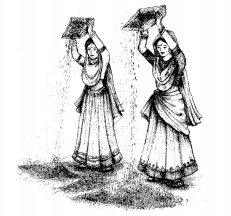
Have you seen anybody winnow grain at dwelling or in a paddy field? What is the give-and-take in your linguistic communication for winnowing? What exercise people utilize for winnowing? (Requite the words in your language, if yous know them.)
Answer:
Yes, I have seen ladies winnow grain in my hamlet. People winnow grains to remove straws, chaff and dust constitute in grains there. It is called 'Barsana'.
More Resources for CBSE Class nine
- NCERT Solutions
- NCERT Solutions Course 9 Maths
- NCERT Solutions Class 9 Science
- NCERT Solutions Class 9 Social Science
- NCERT Solutions Class 9 English
- NCERT Solutions Class 9 Hindi
- NCERT Solutions Class 9 Sanskrit
- NCERT Solutions Class 9 IT
- RD Sharma Class nine Solutions
Question 3.
What does the poet say the wind god winnows?
Respond:
The wind god winnows all the things bachelor at home.
Question iv.
How does we make wind our friend?
Answer:
The poet suggests that we should build potent houses and prepare the doors firmly to brand friends with the wind. Moreover, nosotros should be strong enough to face the difficulties in life.
Question v.
What do the concluding four lines of the poem mean to you?
Reply:
The last 4 lines convey the bulletin that those who are not determined and lack confidence face defeat. And those who set their targets and make sincere efforts are not disturbed past whatever obstruction.
Question 6.
How does the poet speak to the wind—in anger or with humour? You must also have seen or heard of the wind "aging lives". What is your response to this? Is information technology same every bit the poet's?
Answer:
The poet speaks to the current of air with humour. I opine that the poet's behaviour is pertinent and I accept also seen the wind devastating the property mercilessly. The poet invites the air current to attack him and intends to prepare himself for the attack.
Ii.
Question 1.
The poem you have just read is originally in Tamil. Do you know any such poems in your linguistic communication?
Answer:
Yes, I know many poems similar the one given here.
Additional Questions
Curt answer type questions
Question 1.
Who are disturbed past the wind?
Reply:
The current of air disturbs just those people who are non determined. The self confident people overcome the obstacles put before them by the wind. The wind does not have the knack to disturb the peace of heed of such people. The wind blows out weak fires and makes stiff fires roar and flourish.
Question two.
What does the wind do with the books?
Reply:
The wind tears the pages off and throws them down from the book shelf. The potent (powerful) air current scatters the books and sheets of paper on the floor. It disturbs everything.
Question 3.
Why does the author inquire the wind to come swiftly?
Answer:
The author asks the air current to come swiftly so that the earthly peace and order can be retained. The air current damages the shutters of the windows, scatters the papers and tears the pages of books. Information technology disturbs everything and anybody. So, the poet pleads for the welfare of the guild.
Question four.
How does the wind go the cause of rain?
Answer:
The current of air sometimes becomes violent and appears to be a tempest. Information technology brings clouds with information technology from distant lands. There is no need to say that clouds bring pelting. It is a universal truth and scientific fact that clouds bring rain from the bluish sky.
Question five.
Why should the earthly people build stiff houses?
Answer:
They should build potent houses and so that they may not be damaged by the wind. They should be stiff enough to endure violent winds and become a challenge to the stiff wind.
Question 6.
Does the air current god do what we tell him?
Answer:
The wind god is all powerful. He is non influenced by whatever external factors. He doesn't do what we tell him to do. Neither our requests nor our commands will influence him. He is mighty and sweeps away all weaklings with him. He loves force and befriends with stiff and steadfast hearts.
Question seven.
What does the current of air symbolise?
Respond:
The air current symbolises the raw and cruel ability of nature. The wind god is a symbol of might and strength. He hates weaklings. He rather pokes fun at them. Be they are frail houses, crumbling doors or crumbling hearts and bodies, he spares none. He befriends but the strong.
Question 8.
What does the poet ask us to do?
Answer:
The poet wants us to realise the true nature and power of the wind. He advises us to build strong homes. The doors must exist closed firmly. Weak hearts will never succeed. Let u.s.a. make our eye stiff and steadfast. The air current god leaves strength and steadfastness.
Question 9.
Why and how does the wind blow out weak fires? Who roar and flourish?
Answer:
The god of wind is against any and every shaky and weak thing. Our heart should be fired with determination and forcefulness. Weak fires and weaklings are flown out. Only the strong roar and flourish. His friendship is practiced rewarding. Let us praise the current of air, the symbol of power and strength.
Long respond blazon questions
Question 1.
Why does the poet propose the people that they have to be stiff? Write your answer in the context of the poem, 'Wind'.
Answer:
According to the poet, the current of air is very powerful. It has power to break the shutters of the windows, scatter the papers and throw the books down the shelf. When it blows violently, it brings the clouds. Information technology mocks at the weak and destroys their homes. The weak persons are really helpless earlier the wind.
Merely the poet is quite hopeful. He thinks that when the people build strong houses, they tin challenge the wind. Actually the poet suggests the people that they should exist strong at center because the weak persons can not face up the challenges of life. Only the people with potent hearts have the courage to face the challenges of life.
Question ii.
How can y'all say that the poet of the verse form 'Wind' is a swell lover of mankind?
Reply:
The poet wants to make people strong at hearts. His desire is that they should be bold enough to face the challenges of life. When we have strong houses, nosotros can protect ourselves from the aroused wind. In the aforementioned way when nosotros are strong at heart we can face the challenges of life. Only the weak persons are defeated by the issues of life. Similarly the poet wants that people should face the challenges of life and make their life happy. His thought shows that he is actually a swell humanist. His heart is filled with compassion for mankind.
Question 3.
The wind is a symbol of power and strength. How can we befriend it and survive in our struggle for existence?
Answer:
The current of air symbolises the uncontrollable and raw power of nature. The wind god symbolises strength and steadfastness. Weaklings who are weak in the mind and body are swept away by the mighty power of the wind. Only those who are blessed with steadfast minds and hearts survive in the biting struggle of life. The poet gives a broader message. Whatever nosotros do or retrieve must stand on the foundations of strength and power. Only stiff minds and bodies can confront the acrimony of the wind and challenges of life. Nosotros tin befriend the god of wind by building strong homes and doors. We can also win his favour past firming the body and making the heart steadfast.
Value based questions
Question 1.
What moral lesson do you get from the poem 'Current of air'.
Respond:
The poem 'Wind' is full of moral lessons. The poet has poured out his heart in the present poem. He says that people must be strong at heart because only the weak at heart are troubled by difficulties. Here wind symbolises difficulties which has power to devastate life on the earth. Simply if the people are strong at center, they face the challenges thrown out by difficulties. They struggle and at last, come up out with flying colours.
Question ii.
How can you say that friendship with the strong is good?
Answer:
When we have friendship with the strong, we acquire several new things. Nosotros acquire that nosotros may get strong when we fight with difficulties. The people say that if we are strong, the wind may be our friend. Because the wind likes to be friend the potent. So, if we want to accept the strong to be our friends, we have to show backbone ourselves. This is the main reason that the poet talks about the steadfast heart in the poem.
Extract Based Questions (3 marks each)
Read the extract given beneath and respond the questions that follow:
Question 1:
The wind blows out weak fires
He makes strong burn down roar and flourish His friendship is good
We praise him everyday
- How does the air current touch on the weak fires ?
- What is the effect of the wind on strong burn ?
- Trace a give-and-take from the extract that means "prosper".
Answer:
- The wind blows out the weak fires.
- The wind makes the stiff fire even more than potent and increases its power.
- Flourish.
Question 2:
Current of air, come softly
Don't pause the shutters of the windows
Don't scatter the papers
Don't throw downwards the books on the shelf.
- Whom does the poet request in the to a higher place lines ?
- Write whatsoever 1 action of the current of air.
- Trace a word from the extract which means "thrown in different directions".
(Lath Term i,2012, ELI-015)
Respond:
- The poet makes a request to the wind in the above lines.
- Scattering of paper/throwing books from the shelf/breaking the shutters of the window.
- Scatter. (Any ane)
Question iii:
He won't do what yous tell him,
So, come, let's build strong homes.
Let'south articulation the doors firmly Practice to from the body.
Make the center steadfast.
- What does the poet advise ?
- He won't do what you lot tell him", what does it mean ?
- Find a word from the excerpt that means "loyal/faithful".(Lath Term 1,201?, ELI-020)
Reply:
- The poet advises to build strong homes, join the door firmly, and to make our torso house and strong.
- It ways that the current of air does not follow our commands.
- Steadfast.
Question 4:
He won't practise what you call him So, coftie, let'due south build strong homes Let's join the door firmly
Practice to firm the trunk „
Make the heart gteadfast
- What does "he" stands for ?
- What should we do to salvage our homes ?
- The give-and-take which stands for "to fix" is (Lath Term 1,2012, ELI-024)
Answer:
- "He" stands for current of air.
- To save our homes, we should build strong homes and join the door firmly.
- Bring together.
Question 5:
Wind, come softly
Don't intermission the shutters of the windows.
Don't besprinkle the papers
Don't throw down the books on the shelf
There, look what you did – you threw them all down.
You tore the pages of the books.
You brought rain again.
You lot're very clever at poking fun at weaklings.
- Write nearly any two subversive activities of the wind.
- How tin can nosotros make friends with the wind ?
- Find the word from the excerpt which is an antonym of "foolish".
(Lath Term one,2012, ELI-027)
Answer:
- Two destructive activities of the winds are –
(a)Breaks the shutters of windows.
(b)Scatters the papers.
(c)Throws down the books.
(d)Tears the pages of books. (Any 2) - We tin can brand friends with the winds byjbuilding potent homes and strong torso and heart.
- Clever.
Curt Answer Blazon Questions (2 marks each)
(Near thirty-40 words each)
Question one:
Depict the central idea of the poem.
Answer:
The verse form "Air current" inspires the states to face the challenges thrown at us with grit and house conclusion. We should be stiff enough to face all the hardships of life with backbone. Air current symbolizes problems and obstacles that we all face and become through at some indicate fourth dimension in our lives.
Question 2:
Is wind regarded every bit a symbol of destruction in the verse form? Explain.
Answer:
In the poem, offset stanza depicts the destruction caused past wind. The air current tears the pages of the books, brings rain again, and destroys the daily life of the weaker section of the world. The strong or gusty winds represent turmoil and problem in our life. These troubles are to be ignored.
Question iii:
What are the figures of speech in the poem 'Wind'?
Answer:
The most mutual figure of speech in the poem is 'Anaphore' which means repeating of certain words. The repetition of the word 'don't' in the first 3 lines of the poem is an example of Anaphore. As well, the entire poem is a metaphor as information technology ends on a note of application to humanity to stand confronting all ravages, natural or man-made.
Question four:
Can wind ever exist friends with us ?
Answer:
Wind, literally, can be our friend. Wind is a miracle which teaches us to exist strong. Our friends always teach us to exist stiff and determined. In times of need, wind wants united states to bravely face up our obstacles. Hence, we have to be stiff when there are obstacles in our life then that we don't become beaten up past them.
Long Answer Type Questions (4 marks each)
(Nigh 80-100 words each)
Question one:
What challenges are posed past wind in the life of the poet and the common man ?
Respond:
In our lives, wind destructs our daily routine. It hampers and dampens the spirit of life around. Co-ordinate to the poet, rain and wind were deeds of nature that are perceived as the tempest forces which destroy the former and evil inside a human in club to create joy and liberty in his mind. Wind is that difficult natural phenomenon which is very difficult to exist predicted accurately but as our bug which can ascend from nowhere. It can hit us at any time of our life. It mocks the very beingness of existence live. For fragile people, literally and metaphorically, air current creates barriers. Winds practice non let a fragile torso or a delicate mind survive just on the other hand if y'all are strong, you take the power and the will to survive and fight back, wind can never be a threat to your living being.
Question 2:
Does the poem reflect the human being suffering beingness initiated by wind? Explain with examples.
Answer:
I believe that wind is a poignant example of the methaphor of God'south will for a diverseness of reasons. First air current is invisible, merely the effects it has on other aspects of this world are clear and axiomatic. Our poem reflects upon both the effective and destructive paths taken by the air current. Wind is extreme and fierce, but not necessarily legitimately with acrimony and emotions. Wind creates compassion, but apathy at the same time in man life. Winds emphasize the passionate, intense nature of the poet, while the disuse and expiry inherent in the metaphor suggest the sacrifice and suffering of humans. We also see that wind is a metaphor for the god's will because its effects in this world can be both beneficial or ostensibly subversive.
We hope the NCERT Solutions for Class 9 English Poem Chapter ii Air current help you lot. If you accept any query regarding CBSE Class 9 English Poem Chapter two Wind, driblet a annotate beneath and we will go back to y'all at the earliest.
Source: https://www.learncbse.in/ncert-solutions-for-class-9-english-beehive-wind-poem/
0 Response to "Id Do It Over Again I Watch It Blow in the Wind"
Post a Comment