Space Engine Create Binary System Blue Hypergiant Bug
Stars are amongst the most common and important objects in SpaceEngine.
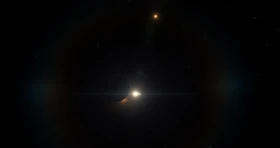
A sextuple star system
They are characterised by a wide range of properties, most importantly their class, which also determines their other properties like size, mass, age, temperature, etc. Of these many classes, low mass stars like red dwarfs are by far the most common.
An average sized galaxy will usually contain several hundreds of billions of stars. However, the largest galaxies in the Universe might even contain several trillion stars.
Perhaps the most important feature of stars are the planetary systems that surround them. Most stars will contain several planets around them, with several of the planets' characteristics being heavily determined by the star they orbit.
Distribution [ ]
In the current versions of SpaceEngine, stars only occur within the boundaries of galaxies. However, there are plans to also add stars that occur in intergalactic space.
Inside galaxies, the density of stars in an area is determined mainly by the distance of the area from the galactic core. Areas near the galactic core will have the highest density of stars in the galaxy.
In spiral galaxies, the density of stars will remain roughly uniform throughout the bulge; it will only begin to sharply decrease as the edges of galaxy are approached. The decrease in stellar density is much more gradual vertically, however. As the player passes through the galactic halo and distances themselves from the bulge, the amount of nearby stars will slowly decrease until eventually it reaches approximately zero when the player reaches a distance of half the galaxy's diameter from the bulge.
In roughly spherical elliptical galaxies, stellar density will also gradually decrease with the distance from the core. However, highly flattened galaxies do not follow this rule, and some areas of these galaxies might be closer than others, yet have a much lower amount of stars.
Irregular galaxies will have stars mostly clustered inside nebulous areas.
Apart from this, the only other factor in the density of stars is the existance of globular clusters. Globular clusters have the highest density of stars in the whole galaxy, comparable to that of the strict galactic core.
Distribution of star types [ ]
The amount of certain star types in an area heavily relies on the type of galaxy and/or the area of the galaxy.
Elliptical galaxies will be dominated by old, post main-sequence stars and low mass stars, with massive main-sequence stars being virtually nonexistant.
The bulge of a spiral galaxy will usually have a mixed composition of stars. However, it seems that the amount of young stars will generally be larger than that of old. The galactic halo and core are, on the other hand, dominated by older stars.
Irregular galaxies have a lot of young, bright blue main-sequence stars, making for a spectacular night sky.
Characteristics [ ]
Spectrum [ ]
The spectrum of a star refers to a star's position within the Hertzsprung–Russell diagram, based on its absolute magnitude and color. With regards to color, SpaceEngine uses the Harvard system, using a letter to represent a star's color and a number ranging from 0 to 9 to represent a star's temperature with respect to other stars within that class (0 is hottest, 9 is coldest). With regards to luminosity (and, in turn, star size), the program uses the Yerkes spectral classification system, using values ranging from 0 (largest) to VI (smallest).
The symbols for star color are as follows:
- O - Blue
- B - Blue (though less hot than their O-type counterparts)
- A - White-Blue
- F - White
- G - Yellow
- K - Orange
- M - Red
- L - Brown dwarf (hot)
- T - Brown dwarf (cool)
- Y - Brown dwarf (very cool)
Note that star color varies inside of spectral class - the sun appears white while G9V stars appear light yellow.
The symbols for the absolute magnitude of a star are as follows:
- 0 - Hypergiant
- Ia - Luminous supergiant
- I - Supergiant
- II - Bright giant
- III - Giant
- IV - Subgiant
- V - Main-sequence
- VI - Subdwarf
- C - Carbon star
- WR - Wolf-Rayet
- WD - White dwarf
SpaceEngine also contain stars whose luminosities are unable to be plotted on the Hertzsprung-Russell diagram:
- Q - Neutron star
- X - Black hole
- Z - Wormhole
- P - Planemo (sub-brown dwarfs, rogue planets)
Diameter [ ]
The diameter of the star, this parameter depends on the star's absolute magnitude class and mass. If two stars are of the same absolute magnitude class, the difference in their diameter will be chiefly determined by their respective masses. So, for example, if two stars are both in the main sequence, but one star has a mass of 4 solar masses and the other has a mass of 28 solar masses, the latter will be larger in diameter than the first.
If two stars belong to different absolute magnitude groups, however, the difference in diameter will be determined by which absolute magnitude groups the stars belong to, in some cases making mass irrelevant. For example, if one star is in the main-sequence, and another is a giant, the giant will be larger than the main-sequence star, regardless of their masses.
The possible diameters of stars range from a mere few kilometers(for neutron stars) up to over 10AU(for some supergiants and hypergiants).
Mass [ ]
Another very important parameter of a star. The mass of a star determines the diameter of a star(though to a much lesser degree than absolute magnitude class), the temperature(also with input from the absolute magnitude class) and lifetime, which also affects the age of the star by limiting how old the star can be.
The lower limit to the mass of a regular star is around 80 Jupiter masses(around 0.076 solar masses, however brown dwarfs can have even lower masses), while the upper limit seems to be around 80 solar masses. (though stars in space engine generate up to 300).
Temperature [ ]
The temperature on the surface of the star. Note that temperature is not uniform across the surface of the star, since, for example, sunspots would be cooler than surrounding regions, and very oblate stars have lower temperatures on the the equator than on their poles. So the temperature parameter represents the average temperature on the surface.
It is determined by the star's type/mass. Red stars are cool, while blue are hot. Although mass is a major factor in the temperature of main-sequence stars, it becomes much less relevant for post main-sequence stars. For post main-sequence stars, diameter is much more important. Of these evolved stars, compact ones(those with a diameter less than around 0.5AU) will have higher temperatures and colors closer to blue(blue giants, white giants). Larger stars, on the other hand, will have low surface temperatures and colors closer to red(red supergiants, orange giants).
Temperature ranges from just a few hundred Kelvin for the coolest brown dwarfs up to hundreds of thousands of Kelvin for some neutron stars.
Luminosity [ ]
Luminosity is the total amount of energy emitted by a star(though it is used for other objects as well, such as galaxies). It is closely related to the mass and absolute magnitude class.
Stars with a high mass are likely to have a higher luminosity than lower mass stars of the same absolute magnitude class. Similarly, stars of a lower absolute magnitude class will usually have a higher luminosity than those with a higher one(so an M3 II star will have a higher luminosity than a G4 V star).
Luminosity can range from less than a watt(for black holes) up to over 2 million (for WOH G64).
Oblateness [ ]
Represents the flattening of the star at it's poles. It is determined by the diameter to rotation period ratio. Most stars have a very low oblateness which is practically unnoticable. However, some main-sequence stars with short rotation periods can actually have a noticeable oblateness, up to the point where the difference between their equatorial and polar diameter is enough to cause equatorial regions to be visibly cooler and darker than polar regions(this is only visible if real star brightness is turned off, however).
Star Types [ ]
Main-Sequence [ ]
Red Dwarf [ ]
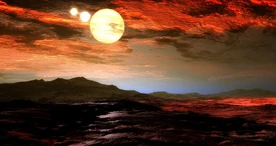
A red dwarf star
Red dwarfs are by far the most common type of star in any galaxy. They are usually found in a binary relationship with other low mass stars. They occupy the region in the Hertzsprung-Russell diagram between M0V and M9V, being the least massive and luminous type of main-sequence star, with some having a mass as small as around 80 Jupiter masses. Almost all contain a planetary system, with a large portion also containing habitable worlds. These worlds are so close to the sun that they are typically tidally locked.
Temperatures range from 2500K for the least massive, to 3900K for the most massive(up to half a solar mass).
The only regions where red dwarfs seem to be a minority are young, open clusters. Globular clusters have an abundance of red dwarfs, on the other hand, due to their age.
Orange Dwarf [ ]
Orange dwarfs are another common type of main-sequence star, however they
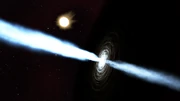
An orange dwarf orbiting a neutron star
are not nearly as common as red dwarfs (15% compared to 75%). They lie in the region between K0V and K9V in the Hertzsprung-Russel diagram, with temperatures ranging from 3900K(least massive, around half a solar mass) up to 5300K(most massive, up to 0.8 solar masses).
In terms of planetary systems, they are similar to red dwarfs. Most planets with temperatures anywhere above freezing will be close to the star itself, and will be tidally locked. This is especially true for late-K stars.
Yellow Dwarf [ ]
Yellow dwarfs are Sun-like stars, and they lie in the region between G0V and G9V in the Hertzsprung-Russel diagram. In the night sky of planets, stars of this spectral type can be seen from up to 100 light years away, making them common in the night sky. (This assumes a limiting magnitude of 7).
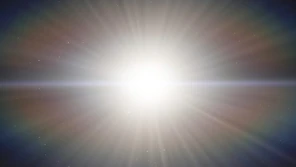
A very bright yellow dwarf
Their temperatures range from 5300K up to 6100K. Their mass ranges from around 0.8 solar masses up to 1.2 solar masses. Yellow dwarfs are somewhat uncommon at 6% of all stars.
Yellow dwarfs will generally possess at least one habitable world in their planetary system. At this point, temperate planets are no longer tidally locked and are therefore more habitable than their counterparts in lower-mass stars.
White Main-Sequence Star [ ]
Despite being relatively uncommon compared to lower-mass stars (making up 4% of all stars), white main-sequence stars are perhaps the most obvious and common type of star visible in the night sky of many planets. They occupy the region between A0V and F9V in the
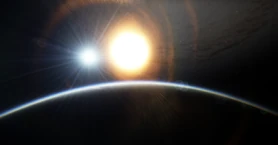
A white main-sequence star by a red giant
Hertzsprung-Russel diagram, ranging in temperature from 6100K for around 1.2 solar masses up to 10000K for 2.3 solar mass A0V stars.
Although white main-sequence stars generally have habitable worlds around them, most life that appears here is usually primitive unicellular since most of these stars appear to be young(less than 1 billion years old).
Blue Main-Sequence Star [ ]
Although these stars are easily the rarest type of main-sequence stars, they are very easy to find due to their impressive brightness which makes them visible even at huge distances. They are located between early O and B9V. They make up 0.2% of all stars.
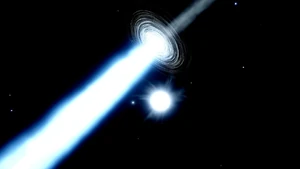
A blue main-sequence star orbiting a supermassive black hole
in the Hertzsprung-Russel diagram. Their temperatures range from around 10,000K up to over 52,000K. The lowest-mass blue main-sequence stars usually have a mass of around 2.5-3 solar masses. The most massive, on the other hand, have masses up to around 75 solar masses, making them one of the most massive stars generated by the engine.
Lower-mass blue main-sequence stars usually posess some sort of planetary system, however life here is exceedingly rare due to the fact that most of these stars live only a few million years. Higher-mass blue main-sequence stars often don't even contain a planet system at all, and even if they do, it is usually very poor and consists of only one or two planets.
Yellow/White Sub Giant [ ]
These stars are slightly rare and are stars that are in the main-
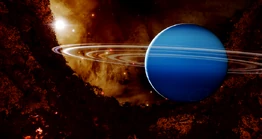
A planet orbiting a white sub giant
sequence, but are brighter than usual. They are relatively easy to find as their brightness make them easy to see. Their temperatures usually range around 5300k to 9600k. About 2% of stars are subgiants and typically these stars are heavier than the sun.
These stars will have a planetary system most of the time, and life isn't to hard to find in these systems. However some systems may have fewer habitable planets as sometimes these stars can have black holes orbiting around them.
Post Main-Sequence Stars [ ]
Red Giant/Bright Giant [ ]
A relatively rare type of star that occurs in all parts of a galaxy, it
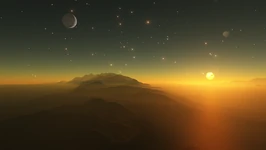
A red giant warming a planet and its two moons
represents a low-mass or intermediate-mass star at the very end of it's life. These stars will usually be huge - very frequently above 1AU in diameter and sometimes up to 10AU. Despite the brilliant brightness and size, these stars tend to have a very low temperature - sometimes as low as around 2500K.
Most of these stars possess some sort of planetary system. However, due to the short lifespan of these stars and the fact that any life that might have appeared during the main-sequence phase was likely destroyed during the rapid growth of the star, current life is very uncommon in this hostile environment.
Due to the tiny part of their lives of which stars are in this stage, red giants only take up 0.5% of all stars. Orange and yellow giants - smaller giant stars with higher temperature - take up another 1% and bright giants, luminous giant stars formed by stars ranging from 3-8 sun masses take up even less.
Orange/Yellow Giant [ ]
A smaller version of their red counterparts, these stars are in fact progenitors to red giants. They represent stars that have left their main-sequence and are expanding, however they have not yet reached their stellar maximum(the red giant phase). They usually have a diameter of less than 0.2AU, so their temperature is still high enough not to make them appear 'red'. These stars are very common inside globular clusters, however are also present in other parts of the galaxy as well.
White/Blue giant [ ]
Stars that have just left the main-sequence, white and blue giants are relatively common inside open clusters. They
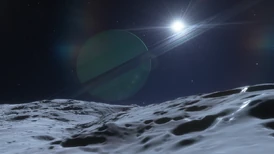
A blue giant casting a blue glow on some rings
will usually be only a few times the diameter of the Sun, hence the fact that they still retain a temperature high enough to be blue/white. They will almost always possess a planetary system.
Red supergiant/hypergiant [ ]
Extremely large, these stars are the successors to the high-mass main-sequence stars. Their diameter sometimes even exceeds 10AU, making them by far the largest stars in a galaxy. They usually come with a binary partner, most often a massive star still in the main-sequence or more rarely a stellar remnant.
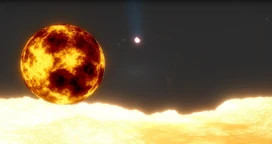
A molten moon orbiting a red hyper giant
Most often they do not contain a planetary system at all. Even when they do, the planetary system is usually quite poor, containing only one or two planets at an extreme distance from the star.
Orange/Yellow/White/Blue supergiant/hypergiant [ ]
Very massive stars on their way to becoming a red supergiant or hypergiant. Like the other giants, they usually have poor planetary systems, and sometimes come with a binary partner.
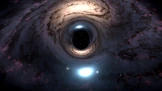
A blue super giant being lensed by a black hole
Wolf-Rayet star [ ]
Among the most massive stars in a galaxy, Wolf-Rayet stars are characterised by their immense stellar wind that rapidly expel large amounts of mass from a star. Their colors range from bright white to bright blue. These stars also don't live long and can explode in less than a million years. While planned, SpaceEngine does not currently simulate star evolution and supernova events.
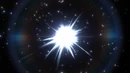
A wolf rayet star
Stellar remnants [ ]
White dwarf [ ]
These are the remains of Sun-like stars. They are the least massive type of stellar remnant, with their upper mass limit being around 1.4 solar masses. They are quite dense, since they usually contain a mass comparable to that of the Sun in a volume comparable
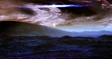
A white dwarf
to that of the Earth. Most planets that orbit a white dwarf are ferrous.
Neutron star [ ]
The remains of high-mass stars, neutron stars are best characterized by their immense density. They have a mass of up to 3 solar masses, yet are only a few kilometers in diameter, hence their density. Since such a large mass is concentrated in such a small volume, neutron stars will have a very noticeable gravitational lens around themselves.
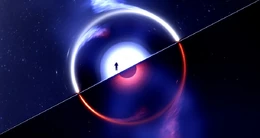
A neutron star with an accreation with a disc
Since they are the result of violent supernovae, planetary systems will very rarely generate around them, and even when they do generate, they will only consist of one large asteroid belt at a huge distance from the star.
Black hole [ ]
Black holes are the remains of the most massive stars. They are above the mass of 3 solar masses, all of which is concentrated in an extremely small volume, so their escape velocity is greater than the speed of light itself, hence the black appearance. They contain a gravitational lens around themselves, similar to neutron stars.
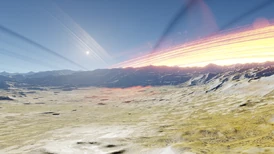
A black hole's disc
Apart from their occurrence in interstellar space, black holes also appear in the centers of globular clusters and galaxies(in the form of supermassive black holes).
Source: https://spaceengine.fandom.com/wiki/Star
0 Response to "Space Engine Create Binary System Blue Hypergiant Bug"
Post a Comment