Family in Renaissance Florence: I Libri Della Famiglia. Book Three
| Leon Battista Alberti | |
|---|---|
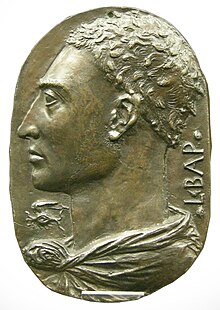 Presumed self-portrait of Leon Battista Alberti | |
| Built-in | 14 Feb 1406 Genoa, Republic of Genoa |
| Died | 25 April 1472(1472-04-25) (aged 68) Rome, Papal States |
| Nationality | Italian |
| Known for | Architecture, linguistics, poetry |
| Notable work | Tempio Malatestiano, Palazzo Rucellai, Santa Maria Novella |
| Movement | Italian Renaissance |
Leon Battista Alberti (Italian: [leˈom batˈtista alˈbɛrti]; fourteen February 1406 – 25 April 1472) was an Italian Renaissance humanist writer, artist, architect, poet, priest, linguist, philosopher, and cryptographer; he epitomised the nature of those identified now every bit polymaths. He is considered the founder of Western cryptography, a claim he shares with Johannes Trithemius.[1] [2]
Although he often is characterized exclusively every bit an architect, as James Beck has observed,[3] "to single out one of Leon Battista's 'fields' over others as somehow functionally independent and self-sufficient is of no assistance at all to any effort to characterize Alberti's extensive explorations in the fine arts". Although Alberti is known mostly for being an artist, he was also a mathematician of many sorts and fabricated bang-up advances to this field during the fifteenth century.[4] The two most important buildings he designed are the churches of San Sebastiano (1460) and Sant'Andrea (1472), both in Mantua.[5]
Alberti's life was described in Giorgio Vasari's Lives of the Near Excellent Painters, Sculptors, and Architects.
Biography [edit]
Early on life [edit]

A portrait of Alberti by Filippino Lippi is idea to exist in the Brancacci Chapel, as role of Lippi'south completion of the Masaccio painting, the Raising of the Son of Theophilus and St. Peter Enthroned
Leon Battista Alberti was built-in in 1406 in Genoa. His mother was Bianca Fieschi. His begetter, Benedetto Alberti, was a wealthy Florentine who had been exiled from his own city, but allowed to return in 1428. Alberti was sent to boarding schoolhouse in Padua, then studied law at Bologna.[half dozen] [7] He lived for a time in Florence, and so in 1431 travelled to Rome, where he took holy orders and entered the service of the papal courtroom.[8] During this fourth dimension he studied the aboriginal ruins, which excited his involvement in architecture and strongly influenced the form of the buildings that he designed.[8]
Alberti was gifted in many ways. He was tall, potent, and a fine athlete who could ride the wildest horse and jump over a person's head.[9] He distinguished himself as a author while still a child at school, and by the historic period of twenty had written a play that was successfully passed off as a genuine slice of Classical literature.[7] In 1435 he began his first major written piece of work, Della pittura, which was inspired by the burgeoning pictorial art in Florence in the early on fifteenth century. In this piece of work he analysed the nature of painting and explored the elements of perspective, composition, and color.[8]
In 1438 he began to focus more on architecture and was encouraged by the Marchese Leonello d'Este of Ferrara, for whom he built a small triumphal arch to support an equestrian statue of Leonello'southward father.[7] In 1447 Alberti became architectural advisor to Pope Nicholas V and was involved in several projects at the Vatican.[vii]
First major commission [edit]
His first major architectural commission was in 1446 for the facade of the Rucellai Palace in Florence. This was followed in 1450 past a commission from Sigismondo Malatesta to transform the Gothic church of San Francesco in Rimini into a memorial chapel, the Tempio Malatestiano.[viii] In Florence, he designed the upper parts of the facade for the Dominican church of Santa Maria Novella, famously bridging the nave and lower aisles with ii ornately inlaid scrolls, solving a visual problem and setting a precedent to be followed by architects of churches for 4 hundred years.[x] In 1452, he completed De re aedificatoria, a treatise on architecture, using every bit its footing the work of Vitruvius and influenced by the archaeological remains of Rome. The work was not published until 1485. It was followed in 1464 by his less influential work, De statua, in which he examines sculpture.[8] Alberti's only known sculpture is a self-portrait medallion, sometimes attributed to Pisanello.

Alberti was employed to design two churches in Mantua, San Sebastiano, which was never completed and for which Alberti's intention can only exist speculated upon, and the Basilica of Sant'Andrea. The design for the latter church was completed in 1471, a year before Alberti'due south death, just was brought to completion and is his most pregnant work.[10]
Alberti as creative person [edit]
As an artist, Alberti distinguished himself from the ordinary craftsman educated in workshops. He was a humanist who followed Aristotle and Plotinus, and part of the rapidly expanding entourage of intellectuals and artisans supported by the courts of the princes and lords of the time. As a member of noble family and as part of the Roman curia, Alberti had special condition. He was a welcomed guest at the Este court in Ferrara, and in Urbino he spent part of the hot-weather season with the soldier-prince Federico 3 da Montefeltro. The Duke of Urbino was a shrewd armed services commander, who generously spent coin on the patronage of fine art. Alberti planned to dedicate his treatise on architecture to his friend.[ix]
Among Alberti'southward smaller studies, pioneering in their field, were a treatise in cryptography, De componendis cifris, and the starting time Italian grammar. With the Florentine cosmographer Paolo Toscanelli he collaborated in astronomy, a close science to geography at that time, and he produced a small Latin work on geography, Descriptio urbis Romae (The Panorama of the City of Rome). Only a few years before his decease, Alberti completed De iciarchia (On Ruling the Household), a dialogue almost Florence during the Medici dominion.
Having taken holy orders, Alberti never married. He loved animals and had a pet dog, a mongrel, for whom he wrote a panegyric, (Canis).[9] Vasari describes Alberti as "an admirable denizen, a human being of culture... a friend of talented men, open and courteous with everyone. He always lived honourably and like the admirer he was."[11] Alberti died in Rome on 25 April 1472 at the age of 66.
Publications [edit]
Alberti regarded mathematics as a starting point for the discussion of art and the sciences. "To brand clear my exposition in writing this brief commentary on painting," Alberti began his treatise, Della Pittura (On Painting) that he dedicated to Brunelleschi, "I volition accept first from the mathematicians those things with which my subject is concerned."[12]
Della pittura (also known in Latin as De Pictura) relied on its scientific content on classical eyes in determining perspective as a geometric instrument of artistic and architectural representation. Alberti was well-versed in the sciences of his age. His knowledge of optics was connected to the handed-downwardly long-continuing tradition of the Kitab al-manazir (The Eyes; De aspectibus) of the Arab polymath Alhazen (Ibn al-Haytham, d. c. 1041), which was mediated by Franciscan optical workshops of the thirteenth-century Perspectivae traditions of scholars such equally Roger Bacon, John Peckham, and Witelo (like influences are also traceable in the third commentary of Lorenzo Ghiberti, Commentario terzo).[13]

English language title folio of the first edition of Giacomo Leoni's translation of Alberti'due south De Re Aedificatoria (1452) - the book is bilingual, with the Italian version beingness printed on the left and the English version printed on the right
In both Della pittura and De statua, Alberti stressed that "all steps of learning should exist sought from nature".[14] The ultimate aim of an creative person is to imitate nature. Painters and sculptors strive "through by different skills, at the same goal, namely that equally nigh equally possible the work they have undertaken shall announced to the observer to be similar to the real objects of nature".[14] Withal, Alberti did non mean that artists should imitate nature objectively, every bit it is, but the artist should be especially circumspect to beauty, "for in painting beauty is as pleasing as it is necessary".[fourteen] The work of art is, according to Alberti, so synthetic that it is impossible to take anything away from information technology or to add anything to it, without impairing the beauty of the whole. Beauty was for Alberti "the harmony of all parts in relation to 1 another," and after "this concord is realized in a particular number, proportion, and arrangement demanded by harmony". Alberti's thoughts on harmony were not new—they could be traced dorsum to Pythagoras—but he set them in a fresh context, which fit in well with the contemporary aesthetic discourse.
In Rome, Alberti had enough of fourth dimension to study its aboriginal sites, ruins, and objects. His detailed observations, included in his De re aedificatoria (1452, On the Art of Edifice),[15] were patterned after the De architectura past the Roman architect and engineer Vitruvius (fl. 46–xxx BC). The piece of work was the first architectural treatise of the Renaissance. It covered a broad range of subjects, from history to town planning, and engineering to the philosophy of beauty. De re aedificatoria, a big and expensive book, was non fully published until 1485, later which it became a major reference for architects.[16] Notwithstanding, the book was written "not only for craftsmen but too for anyone interested in the noble arts", as Alberti put it.[fifteen] Originally published in Latin, the outset Italian edition came out in 1546. and the standard Italian edition by Cosimo Bartoli was published in 1550. Pope Nicholas Five, to whom Alberti dedicated the whole work, dreamed of rebuilding the city of Rome, but he managed to realize simply a fragment of his visionary plans. Through his book, Alberti opened up his theories and ideals of the Florentine Renaissance to architects, scholars, and others.
Alberti wrote I Libri della famiglia—which discussed education, marriage, household management, and money—in the Tuscan dialect. The work was non printed until 1843. Similar Erasmus decades later, Alberti stressed the need for a reform in educational activity. He noted that "the intendance of very young children is women's work, for nurses or the female parent", and that at the earliest possible age children should be taught the alphabet.[14] With corking hopes, he gave the work to his family to read, merely in his autobiography Alberti confesses that "he could hardly avert feeling rage, moreover, when he saw some of his relatives openly ridiculing both the whole work and the writer's futile enterprise along it".[14] Momus, written between 1443 and 1450, was a notable one-act about the Olympian deities. It has been considered as a roman à clef—Jupiter has been identified in some sources as Pope Eugenius IV and Pope Nicholas V. Alberti borrowed many of its characters from Lucian, one of his favorite Greek writers. The name of its hero, Momus, refers to the Greek word for arraign or criticism. After beingness expelled from heaven, Momus, the god of mockery, is eventually castrated. Jupiter and the other deities come downward to world also, merely they return to heaven subsequently Jupiter breaks his nose in a great storm.
Architectural works [edit]

The dramatic facade of Sant' Andrea, Mantua, (1471) congenital to Alberti'southward pattern after his death

The unfinished and altered facade of San Sebastiano has promoted much speculation as to Alberti's intentions.
Alberti did not concern himself with the practicalities of building, and very few of his major works were brought to completion. As a designer and a student of Vitruvius and of ancient Roman remains, he grasped the nature of cavalcade and lintel architecture, from the visual rather than structural viewpoint, and correctly employed the Classical orders, unlike his contemporary, Brunelleschi, who used the Classical column and pilaster in a free interpretation. Among Alberti's concerns was the social consequence of compages, and to this end he was very well enlightened of the cityscape.[x] This is demonstrated past his inclusion, at the Rucellai Palace, of a continuous bench for seating at the level of the basement. Alberti anticipated the principle of street hierarchy, with wide main streets continued to secondary streets, and buildings of equal height.[17]
In Rome he was employed by Pope Nicholas V for the restoration of the Roman channel of Acqua Vergine, which debouched into a simple basin designed past Alberti, which was swept away afterwards by the Bizarre Trevi Fountain.
In some studies,[18] the authors propose that the Villa Medici in Fiesole might owe its blueprint to Alberti, not to Michelozzo, and that it then became the prototype of the Renaissance villa. This hilltop abode, commissioned past Giovanni de' Medici, Cosimo il Vecchio's second son, with its view over the city, may be the very offset case of a Renaissance villa: that is to say it follows the Albertian criteria for rendering a country dwelling a "villa suburbana". Under this perspective the Villa Medici in Fiesole could therefore exist considered the "muse" for numerous other buildings, not only in the Florence area, which from the terminate of the fifteenth century onward find inspiration and artistic innovation from it.
Tempio Malatestiano, Rimini [edit]
The Tempio Malatestiano in Rimini (1447, 1453–60)[19] is the rebuilding of a Gothic church. The facade, with its dynamic play of forms, was left incomplete.[10]
Façade of Palazzo Rucellai [edit]
The design of the façade of the Palazzo Rucellai (1446–51) was ane of several commissions for the Rucellai family unit.[nineteen] The design overlays a grid of shallow pilasters and cornices in the Classical manner onto rusticated masonry, and is surmounted by a heavy cornice. The inner courtyard has Corinthian columns. The palace ready a standard in the employ of Classical elements that is original in borough buildings in Florence, and profoundly influenced later palazzi. The work was executed by Bernardo Rosselino.[10]

Tempio Malatestiano, Rimini

Santa Maria Novella [edit]
At Santa Maria Novella, Florence, between (1448–70)[19] the upper facade was synthetic to the pattern of Alberti. It was a challenging task, as the lower level already had three doorways and six Gothic niches containing tombs and employing the polychrome marble typical of Florentine churches, such as San Miniato al Monte and the Baptistery of Florence. The design besides incorporates an ocular window that was already in place. Alberti introduced Classical features around the portico and spread the polychromy over the entire facade in a manner that includes Classical proportions and elements such as pilasters, cornices, and a pediment in the Classical style, ornamented with a sunburst in tesserae, rather than sculpture. The best known feature of this typically aisled church is the manner in which Alberti has solved the problem of visually bridging the different levels of the central nave and much lower side aisles. He employed ii large scrolls, which were to become a standard feature of church facades in the later Renaissance, Bizarre, and Classical Revival buildings.[10]
Pienza [edit]

Piazza Pio II in Pienza, looking toward the Palazzo Piccolomini
Alberti is considered to accept been the consultant for the blueprint of the Piazza Pio 2, Pienza. The village, previously called Corsignano, was redesigned beginning around 1459.[nineteen] It was the birthplace of Aeneas Silvius Piccolomini, Pope Pius Ii, in whose apply Alberti served. Pius II wanted to use the hamlet as a retreat, but needed for information technology to reflect the dignity of his position.
The piazza is a trapezoid shape defined by four buildings, with a focus on Pienza Cathedral and passages on either side opening onto a landscape view. The principal residence, Palazzo Piccolomini, is on the western side. It has iii stories, articulated by pilasters and entablature courses, with a twin-lighted cross window set within each bay. This structure is like to Alberti's Palazzo Rucellai in Florence and other subsequently palaces. Noteworthy is the internal court of the palazzo. The back of the palace, to the s, is defined past loggia on all three floors that overlook an enclosed Italian Renaissance garden with Giardino all'italiana era modifications, and spectacular views into the distant landscape of the Val d'Orcia and Pope Pius'south beloved Mount Amiata beyond. Beneath this garden is a vaulted stable that had stalls for a hundred horses. The blueprint, which radically transformed the eye of the town, included a palace for the pope, a church, a town hall, and a building for the bishops who would accompany the Pope on his trips. Pienza is considered an early on instance of Renaissance urban planning.
Sant' Andrea, Mantua [edit]
The Basilica of Sant'Andrea, Mantua was begun in 1471,[nineteen] the yr before Alberti'south expiry. It was brought to completion and is his most significant work employing the triumphal arch motif, both for its facade and interior, and influencing many works that were to follow.[10] Alberti perceived the role of architect equally designer. Unlike Brunelleschi, he had no interest in the construction, leaving the practicalities to builders and the oversight to others.[10]
Other buildings [edit]
- San Sebastiano, Mantua, (begun 1458)[nineteen] the unfinished facade of which has promoted much speculation equally to Alberti's intention [ten]
- Sepolcro Rucellai in San Pancrazio, 1467)[19]
- The Tribune for Santissima Annunziata, Florence (1470, completed with alterations, 1477)[19]
Painting [edit]
Giorgio Vasari, who argued that historical progress in art reached its peak in Michelangelo, emphasized Alberti's scholarly achievements, not his artistic talents: "He spent his time finding out about the world and studying the proportions of antiquities; but above all, following his natural genius, he full-bodied on writing rather than on applied work."[11] Leonardo, who ironically called himself "an uneducated person" (omo senza lettere), followed Alberti in the view that painting is science. Nonetheless, equally a scientist, Leonardo was more empirical than Alberti, who was a theorist and did not accept like interest in practice. Alberti believed in platonic beauty, merely Leonardo filled his notebooks with observations on human proportions, page after page, ending with his famous drawing of the Vitruvian man, a man figure related to a foursquare and a circumvolve.
In On Painting, Alberti uses the expression "We Painters", but equally a painter, or sculptor, he was a dilettante. "In painting Alberti achieved zip of any great importance or beauty", wrote Vasari.[11] "The very few paintings of his that are extant are far from perfect, but this is not surprising since he devoted himself more than to his studies than to draughtsmanship." Jacob Burckhardt portrayed Alberti in The Culture of the Renaissance in Italia as a truly universal genius. "And Leonardo Da Vinci was to Alberti as the finisher to the beginner, as the master to the dilettante. Would but that Vasari's piece of work were here supplemented by a clarification like that of Alberti! The colossal outlines of Leonardo's nature tin can never exist more dimly and distantly conceived."[ix]
Alberti is said to appear in Mantegna's great frescoes in the Camera degli Sposi, equally the older homo dressed in nighttime carmine clothes, who whispers in the ear of Ludovico Gonzaga, the ruler of Mantua.[20] In Alberti'due south self-portrait, a big plaquette, he is clothed as a Roman. To the left of his contour is a winged eye. On the opposite side is the question, Quid tum? (what and so), taken from Virgil's Eclogues: "So what, if Amyntas is nighttime? (quid tum si fuscus Amyntas?) Violets are black, and hyacinths are black."[21]
Contributions [edit]

Alberti made a diverseness of contributions to several fields:
- Alberti was the creator of a theory chosen "historia". In his treatise De pictura (1435) he explains the theory of the accumulation of people, animals, and buildings, which create harmony amongst each other, and "agree the center of the learned and unlearned spectator for a long while with a certain sense of pleasance and emotion". De pictura ("On Painting") contained the kickoff scientific study of perspective. An Italian translation of De pictura (Della pittura) was published in 1436, one yr after the original Latin version and addressed Filippo Brunelleschi in the preface. The Latin version had been dedicated to Alberti'south humanist patron, Gianfrancesco Gonzaga of Mantua. He as well wrote works on sculpture, De statua.
- Alberti used his artistic treatises to propound a new humanistic theory of fine art. He drew on his contacts with early Quattrocento artists such as Brunelleschi, Donatello, and Ghiberti to provide a practical handbook for the renaissance creative person.
- Alberti wrote an influential work on architecture, De re aedificatoria, which by the sixteenth century had been translated into Italian (past Cosimo Bartoli), French, Spanish, and English. An English translation was by Giacomo Leoni in the early eighteenth century. Newer translations are now available.
- Whilst Alberti's treatises on painting and compages accept been hailed equally the founding texts of a new grade of art, breaking from the Gothic past, it is incommunicable to know the extent of their practical impact inside his lifetime. His praise of the Calumny of Apelles led to several attempts to emulate it, including paintings by Botticelli and Signorelli. His stylistic ideals have been put into practice in the works of Mantegna, Piero della Francesca, and Fra Angelico. But how far Alberti was responsible for these innovations and how far he was simply articulating the trends of the artistic motion, with which his practical feel had fabricated him familiar, is incommunicable to ascertain.
- He was then skilled in Latin poesy that a comedy he wrote in his twentieth twelvemonth, entitled Philodoxius, would subsequently deceive the younger Aldus Manutius, who edited and published it as the genuine work of 'Lepidus Comicus'.
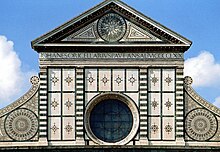
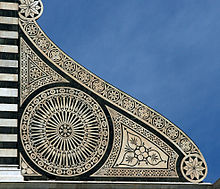
Ane of the giant scrolls at Santa Maria Novella
- He has been credited with existence the author, or alternatively, the designer of the woodcut illustrations, of the Hypnerotomachia Poliphili, a strange fantasy novel.[22]
- Apart from his treatises on the arts, Alberti also wrote: Philodoxus ("Lover of Celebrity", 1424), De commodis litterarum atque incommodis ("On the Advantages and Disadvantages of Literary Studies", 1429), Intercoenales ("Table Talk", c. 1429), Della famiglia ("On the Family", begun 1432), Vita S. Potiti ("Life of St. Potitus", 1433), De iure (On Law, 1437), Theogenius ("The Origin of the Gods", c. 1440), Profugorium ab aerumna ("Refuge from Mental Anguish",), Momus (1450), and De Iciarchia ("On the Prince", 1468). These and other works were translated and printed in Venice by the humanist Cosimo Bartoli in 1586.
- Alberti was an achieved cryptographer by the standard of his day and invented the starting time polyalphabetic cipher, which is now known as the Alberti zero, and machine-assisted encryption using his Cipher Disk. The polyalphabetic cipher was, at to the lowest degree in principle (for information technology was non properly used for several hundred years) the most significant advance in cryptography since before Julius Caesar's time. Cryptography historian David Kahn entitles him the "Begetter of Western Cryptography", pointing to 3 significant advances in the field that can exist attributed to Alberti: "the earliest Western exposition of cryptanalysis, the invention of polyalphabetic substitution, and the invention of enciphered code".David Kahn (1967). The codebreakers: the story of cloak-and-dagger writing . New York: MacMillan.
- According to Alberti, in a brusk autobiography written c. 1438 in Latin and in the third person, (many just not all scholars consider this work to be an autobiography) he was capable of "standing with his feet together, and springing over a man'south head." The autobiography survives thanks to an eighteenth-century transcription past Antonio Muratori. Alberti besides claimed that he "excelled in all bodily exercises; could, with anxiety tied, leap over a continuing man; could in the great cathedral, throw a money far up to ring against the vault; amused himself by taming wild horses and climbing mountains". Needless to say, many in the Renaissance promoted themselves in diverse means and Alberti's eagerness to promote his skills should be understood, to some extent, within that framework. (This advice should be followed in reading the in a higher place data, some of which originates in this then-called autobiography.)
- Alberti claimed in his "autobiography" to be an accomplished musician and organist, simply there is no hard evidence to back up this merits. In fact, musical posers were not uncommon in his day (run into the lyrics to the song Musica Son, by Francesco Landini, for complaints to this effect.) He held the date of canon in the metropolitan church building of Florence, and thus – perchance – had the leisure to devote himself to this fine art, but this is simply speculation. Vasari also agreed with this.[11]
- He was interested in the drawing of maps and worked with the astronomer, astrologer, and cartographer Paolo Toscanelli.
- In terms of Aesthetics Alberti is one of the first defining the piece of work of art equally imitation of nature, exactly equally a selection of its most beautiful parts: "So let's take from nature what we are going to pigment, and from nature we choose the most beautiful and worthy things".[23]
Works in impress [edit]
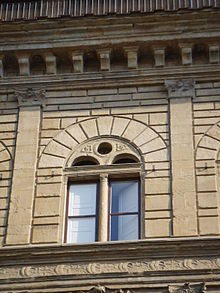
A window of the Rucellai Palace
- De Pictura, 1435. On Painting, in English, De Pictura, in Latin, On Painting. Penguin Classics. 1972. ISBN978-0-fourteen-043331-ix. ; Della Pittura, in Italian (1804 [1434]).
- Momus, Latin text and English translation, 2003 ISBN 0-674-00754-9
- De re aedificatoria (1452, Ten Books on Architecture). Alberti, Leon Battista. De re aedificatoria. On the art of building in ten books. (translated by Joseph Rykwert, Robert Tavernor and Neil Leach). Cambridge, Mass.: MIT Printing, 1988. ISBN 0-262-51060-Ten. ISBN 978-0-262-51060-8. Latin, French and Italian editions and in English translation.
- De Cifris A Treatise on Ciphers (1467), trans. A. Zaccagnini. Foreword past David Kahn, Galimberti, Torino 1997.
- Della tranquillitá dell'animo. 1441.
- "Leon Battista Alberti. On Painting. A New Translation an Critical Edition", Edited and Translated by Rocco Sinisgalli, Cambridge University Press, New York, May 2011, ISBN 978-1-107-00062-9, (books.google.de)
- I libri della famiglia, Italian edition[24]
- "Dinner pieces". A Translation of the Intercenales by David Marsh. Heart for Medieval and Early Renaissance Studies, State University of New York, Binghamton 1987.
- "Descriptio urbis Romae. Leon Battista Alberti's Delineation of the city of Rome". Peter Hicks, Arizona Lath of Regents for Arizona State academy 2007.
Legacy [edit]
Borsi states that Alberti'southward writings on architecture continue to influence modern and contemporary architecture stating: "The organicism and nature-worship of Wright, the neat classicism of van der Mies, the regulatory outlines and anthropomorphic, harmonic, modular systems of Le Corbusier, and Kahn's revival of the 'antique' are all elements that tempt 1 to trace Alberti's influence on modern architecture."[25]
In popular culture [edit]
- Leon Battista Alberti is a major character in Roberto Rossellini's three-function television film The Age of the Medici (1973), with the third and final role, Leon Battista Alberti: Humanism, centering on him, his works (such as Santa Maria Novella), and his thought. He is played by Italian actor Virginio Gazzolo.[26]
- Mentioned in the 1994 film Renaissance Man or Army Intelligence starring Danny DeVito.
- Mentioned in the 2004 book The Dominion of 4 by Ian Caldwell and Dustin Thomason
Notes [edit]
- ^ Leeuw, Karl Maria Michael de; Bergstra, January (28 Baronial 2007). The History of Data Security: A Comprehensive Handbook. Elsevier. p. 283. ISBN978-0-08-055058-9 . Retrieved twenty February 2022.
- ^ Holden, Joshua (two October 2018). The Mathematics of Secrets: Cryptography from Caesar Ciphers to Digital Encryption. Princeton Academy Press. ISBN978-0-691-18331-2 . Retrieved xx Feb 2022.
- ^ James Brook, "Leon Battista Alberti and the 'Night Sky' at San Lorenzo", Artibus et Historiae x, No. 19 (1989:nine–35), p. nine.
- ^ Williams, Kim (August 27, 2010). The Mathematical Works of Leon Battista Alberti. Birkhauser Verlag AG. p. 1. ISBN978-3-0346-0473-iv – via Duke Libraries.
- ^ Norwich, John Julius (1990). Oxford Illustrated Encyclopedia Of The Arts. USA: Oxford University Press. p. 11. ISBN978-0198691372.
- ^ Treccani encyclopedia, Leon Battista Alberti
- ^ a b c d Melissa Snell, Leon Battsta Alberti, About.com: Medieval History.
- ^ a b c d e The Renaissance:a Illustrated Encyclopedia, Octopus (1979) ISBN 0706408578
- ^ a b c d Jacob Burckhardt in The Civilization of the Renaissance Italy, 2.one, 1860.
- ^ a b c d due east f g h i Joseph Rykwert, ed., Leon Baptiste Alberti, Architectul Design, Vol 49 No 5-half dozen, London
- ^ a b c d Vasari, The Lives of the Artists
- ^ Leone Battista Alberti, On Painting, editor John Richard Spencer, 1956, p. 43.
- ^ Nader El-Bizri, "A Philosophical Perspective on Alhazen'due south Eyes", Standard arabic Sciences and Philosophy, vol. 15, event 2 (2005), pp. 189–218 (Cambridge University Press).
- ^ a b c d e Liukkonen, Petri. "Leon Battista Alberti". Books and Writers (kirjasto.sci.fi). Finland: Kuusankoski Public Library. Archived from the original on February 10, 2015.
- ^ a b Alberti, Leon Battista. On the Art of Edifice in 10 Books. Trans. Leach, N., Rykwert, J., & Tavenor, R. Cambridge: The MIT Press, 1988
- ^ Center for Palladian Studies in America, Inc., Palladio's Literary Predecessors
- ^ Caves, R. W. (2004). Encyclopedia of the City. Routledge. p. 12.
- ^ D. Mazzini, S. Simone, Villa Medici a Fiesole. Leon Battista Alberti e il prototipo di villa rinascimentale, Centro Di, Firenze 2004
- ^ a b c d e f m h Franco Borsi. Leon Battista Alberti. New York: Harper & Row, (1977)
- ^ Johnson, Eugene J. (1975). "A Portrait of Leon Battista Alberti in the Camera degli Sposi?". Arte Lombarda, Nuova Serie. 42/43 (42/43): 67–69. JSTOR 43104980.
- ^ Virgil, Bucolica, Chapter Ten.
- ^ Liane Lefaivre, Leon Battista Alberti's Hypnerotomachia Poliphili, Cambridge: MIT Press, 1997
- ^ De Pictura, book Three: Ergo semper quae picturi sumus, ea a natura sumamus, semperque ex his quaeque pulcherrima et dignissima deligamus.
- ^ Alberti, Leon Battista (1908). "I libri della famiglia".
- ^ Brosi, p. 254
- ^ The Criterion Drove, The Age of the Medici (1973) | The Benchmark Drove
References [edit]
- [1] Magda Saura, "Building codes in the architectural treatise De re aedificatoria,"
[2] Tertiary International Congress on Construction History, Cottbus, May 2009.
[iii] http://hdl.handle.cyberspace/2117/14252
Further reading [edit]
- Clark, Kenneth. "Leon Battista Alberti: a Renaissance Personality." History Today (July 1951) 1#7 pp 11-xviii online
- Francesco Borsi, Leon Battista Alberti. Das Gesamtwerk. Stuttgart 1982
- Günther Fischer, Leon Battista Alberti. Sein Leben und seine Architekturtheorie. Wissenschaftliche Buchgesellschaft Darmstadt 2012
- Fontana-Giusti, Korolija Gordana, "The Cutting Surface: On Perspective as a Section, Its Relationship to Writing, and Its Role in Understanding Space" AA Files No. 40 (Wintertime 1999), pp. 56–64 London: Architectural Association School of Compages.
- Fontana-Giusti, Gordana. "Walling and the city: the effects of walls and walling within the urban center space", The Periodical of Architecture pp 309–45 Volume 16, Issue iii, London & New York: Routledge, 2011.
- Gille, Bertrand (1970). "Alberti, Leone Battista". Dictionary of Scientific Biography. Vol. 1. New York: Charles Scribner's Sons. pp. 96–98. ISBN978-0-684-10114-9.
- Anthony Grafton, Leon Battista Alberti. Principal Builder of the Italian Renaissance. New York 2000
- Marking Jarzombek, "The Structural Problematic of Leon Battista Alberti'southward De pictura", Renaissance Studies four/3 (September 1990): 273–285.
- Michel Paoli, Leon Battista Alberti, Torino 2007
- Les Livres de la famille d'Alberti, Sources, sens et influence, sous la direction de Michel Paoli, avec la collaboration d'Elise Leclerc et Sophie Dutheillet de Lamothe, préface de Françoise Choay, Paris, Classiques Garnier, 2013.
- Manfredo Tafuri, Interpreting the Renaissance: Princes, Cities, Architects, trans. Daniel Sherer. New Haven 2006.
- Robert Tavernor, On Alberti and the Fine art of Building. New Haven and London: Yale University Press, 1998. ISBN 978-0-300-07615-eight.
- Vasari, The Lives of the Artists Oxford University Press, 1998. ISBN 0-xix-283410-X
- Wright, D.R. Edward, "Alberti's De Pictura: Its Literary Structure and Purpose", Journal of the Warburg and Courtauld Institutes, Vol. 47, 1984 (1984), pp. 52–71.
LA) Leon Battista Alberti, De re aedificatoria, Argentorati, excudebat Thousand. Iacobus Cammerlander Moguntinus, 1541.
- (LA) Leon Battista Alberti, De re aedificatoria, Florentiae, accuratissime impressum opera magistri Nicolai Laurentii Alamani.
Leon Battista Alberti, Opere volgari. 1, Firenze, Tipografia Galileiana, 1843.
- Leon Battista Alberti, Opere volgari. 2, Firenze, Tipografia Galileiana, 1844.
- Leon Battista Alberti, Opere volgari. 4, Firenze, Tipografia Galileiana, 1847.
- Leon Battista Alberti, Opere volgari. 5, Firenze, Tipografia Galileiana, 1849.
- Leon Battista Alberti, Opere, Florentiae, J. C. Sansoni, 1890.
- Leon Battista Alberti, Trattati d'arte, Bari, Laterza, 1973.
- Leon Battista Alberti, Ippolito e Leonora, Firenze, Bartolomeo de' Libri, prima del 1495.
- Leon Battista Alberti, Ecatonfilea, Stampata in Venesia, per Bernardino da Cremona, 1491.
- Leon Battista Alberti, Deifira, Padova, Lorenzo Canozio, 1471.
- Leon Battista Alberti, Teogenio, Milano, Leonard Pachel, circa 1492.
- Leon Battista Alberti, Libri della famiglia, Bari, G. Laterza, 1960.
- Leon Battista Alberti, Rime due east trattati morali, Bari, Laterza, 1966.
- Albertiana, Rivista della Société Intérnationale Leon Battista Alberti, Firenze, Olschki, 1998 sgg.
- Franco Borsi, Leon Battista Alberti: Opera completa, Electa, Milano, 1973;
Giovanni Ponte, Leon Battista Alberti: Umanista east scrittore, Tilgher, Genova, 1981;
- Paolo Marolda, Crisi e conflitto in Leon Battista Alberti, Bonacci, Roma, 1988;
- Roberto Cardini, Mosaici: Il nemico dell'Alberti, Bulzoni, Roma 1990;
- Rosario Contarino, Leon Battista Alberti moralista, presentazione di Francesco Tateo, Due south. Sciascia, Caltanissetta 1991;
- Pierluigi Panza, Leon Battista Alberti: Filosofia due east teoria dell'arte, introduzione di Dino Formaggio, Guerini, Milano 1994;
- Cecil Grayson, Studi su Leon Battista Alberti, a cura di Paola Claut, Olschki, Firenze 1998;
- Stefano Borsi, Momus, o Del principe: Leon Battista Alberti, i papi, il giubileo, Polistampa, Firenze 1999;
Luca Boschetto, Leon Battista Alberti e Firenze: Biografia, storia, letteratura, Olschki, Firenze 2000;
- Alberto K. Cassani, La fatica del costruire: Tempo eastward materia nel pensiero di Leon Battista Alberti, Unicopli, Milano 2000;
- Elisabetta Di Stefano, L'altro sapere: Bello, arte, immagine in Leon Battista Alberti, Centro internazionale studi di estetica, Palermo 2000;
- Rinaldo Rinaldi, Melancholia Christiana. Studi sulle fonti di Leon Battista Alberti, Firenze, Olschki, 2002;
- Francesco Furlan, Studia albertiana: Lectures et lecteurs de Fifty.B. Alberti, Due north. Aragno-J. Vrin, Torino-Parigi 2003;
- Anthony Grafton, Leon Battista Alberti: Un genio universale, Laterza, Roma-Bari 2003;
D. Mazzini, S. Martini. Villa Medici a Fiesole. Leon Battista Alberti e il prototipo di villa rinascimentale, Centro Di, Firenze 2004;
- Michel Paoli, Leon Battista Alberti 1404–1472, Parigi, Editions de l'Imprimeur, 2004, ISBN 2-910735-88-5, ora tradotto in italiano: Michel Paoli, Leon Battista Alberti, Bollati Boringhieri, Torino 2007, 124 p. + xl ill., ISBN 978-88-339-1755-nine.
- Anna Siekiera, Bibliografia linguistica albertiana, Firenze, Edizioni Polistampa, 2004 (Edizione Nazionale delle Opere di Leon Battista Alberti, Serie «Strumenti», ii);
- Francesco P. Fiore: La Roma di Leon Battista Alberti. Umanisti, architetti e artisti alla scoperta dell'antico nella città del Quattrocento, Skira, Milano 2005, ISBN 88-7624-394-1;
Leon Battista Alberti architetto, a cura di Giorgio Grassi e Luciano Patetta, testi di Giorgio Grassi et alii, Banca CR, Firenze 2005;
- Restaurare Leon Battista Alberti: il caso di Palazzo Rucellai, a cura di Simonetta Bracciali, presentazione di Antonio Paolucci, Libreria Editrice Fiorentina, Firenze 2006, ISBN 88-89264-81-0;
- Stefano Borsi, Leon Battista Alberti e Napoli, Polistampa, Firenze 2006; ISBN 88-88967-58-3
- Gabriele Morolli, Leon Battista Alberti. Firenze due east la Toscana, Maschietto Editore, Firenze, 2006.ù
- F. Canali, "Leon Battista Alberti "Camaleonta" e l'idea del Tempio Malatestiano dalla Storiografia al Restauro, in Il Tempio della Meraviglia, a cura di F. Canali, C. Muscolino, Firenze, 2007.
- F. Canali, La facciata del Tempio Malatestiano, in Il Tempio della Meraviglia, a cura di F. Canali, C. Muscolino, Firenze, 2007.
- V. C. Galati, "Ossa" e "illigamenta" nel De Re aedificatoria. Caratteri costruttivi due east ipotesi strutturali nella lettura della tecnologia antiquaria del cantiere del Tempio Malatestiano, in Il Tempio della Meraviglia, a cura di F. Canali, C. Muscolino, Firenze, 2007.
- Alberti e la cultura del Quattrocento, Atti del Convegno internazionale di Studi, (Firenze, Palazzo Vecchio, Salone dei Dugento, sixteen-17-xviii dicembre 2004), a cura di R. Cardini e Chiliad. Regoliosi, Firenze, Edizioni Polistampa, 2007.
- AA.VV, Brunelleschi, Alberti e oltre, a cura di F. Canali, «Bollettino della Società di Studi Fiorentini», 16–17, 2008.
- F. Canali, R Tracce albertiane nella Romagna umanistica tra Rimini eastward Faenza, in Brunelleschi, Alberti e oltre, a cura di F. Canali, «Bollettino della Società di Studi Fiorentini», xvi–17, 2008.
- V. C. Galati, Riflessioni sulla Reggia di Castelnuovo a Napoli: morfologie architettoniche due east tecniche costruttive. Un univoco cantiere antiquario tra Donatello e Leon Battista Alberti?, in Brunelleschi, Alberti due east oltre, a cura di F. Canali, «Bollettino della Società di Studi Fiorentini», 16–17, 2008.
- F. Canali, Five. C. Galati, Leon Battista Alberti, gli 'Albertiani' e la Puglia umanistica, in Brunelleschi, Alberti east oltre, a cura di F. Canali, «Bollettino della Società di Studi Fiorentini», 16–17, 2008.
- G. Morolli, Alberti: la triiplice luce della pulcritudo, in Brunelleschi, Alberti e oltre, a cura di F. Canali, «Bollettino della Società di Studi Fiorentini», xvi–17, 2008.
- G. Morolli, Pienza eastward Alberti, in Brunelleschi, Alberti e oltre, a cura di F. Canali, «Bollettino della Società di Studi Fiorentini», xvi–17, 2008.
- Christoph Luitpold Frommel, Alberti eastward la porta trionfale di Castel Nuovo a Napoli, in «Annali di architettura» northward° 20, Vicenza 2008 leggere l'articolo;
Massimo Bulgarelli, Leon Battista Alberti, 1404-1472: Architettura e storia, Electa, Milano 2008;
- Caterina Marrone, I segni dell'inganno. Semiotica della crittografia, Stampa Alternativa&Graffiti, Viterbo 2010;
- S. Borsi, Leon Battista Alberti eastward Napoli, Firenze, 2011.
- Five. Galati, Il Torrione quattrocentesco di Bitonto dalla committenza di Giovanni Ventimiglia east Marino Curiale; dagli adeguamenti ai dettami del De Re aedificatoria di Leon Battista Alberti alle proposte di Francesco di Giorgio Martini (1450-1495), in Defensive Architecture of the Mediterranean XV to XVIII centuries, a cura di 1000. Verdiani, Firenze, 2016, vol.III.
- 5. Galati, Tipologie di Saloni per le udienze nel Quattrocento tra Ferrara e Mantova. Oeci, Basiliche, Curie e "Logge all'antica" tra Vitruvio e Leon Battista Alberti nel "Salone dei Mesi di Schifanoia a Ferrara e nella "Camera Picta" di Palazzo Ducale a Mantova, in Per amor di Classicismo, a cura di F. Canali «Bollettino della Società di Studi Fiorentini», 24–25, 2016.
- South. Borsi, Leon Battista, Firenze, 2018.
External links [edit]
- Albertian Bibliography on line
- MS Typ 422.two. Alberti, Leon Battista, 1404–1472. Ex ludis rerum mathematicarum : manuscript, [14--]. Houghton Library, Harvard University.
- Palladio's Literary Predecessors
- "Learning from the City-States? Leon Battista Alberti and the London Riots", Caspar Pearson, Berfrois, September 26, 2011
- Online resources for Alberti's buildings
- Alberti Photogrammetric Drawings [4]
- S. Andrea, Mantua, Italia
- Sta. Maria Novella, Florence, Italia
- Alberti's works online
- De pictura/Della pittura, original Latin and Italian texts (English translation)
- Libri della famiglia – Libro 3 – Dignità del volgare on sound MP3
- Momus, (printed in Rome in 1520), full digital facsimile, CAMENA Project
- The Compages of Leon Battista Alberti in 10 Books, (printed in London in 1755), full digital facsimile, Linda Hall Library
- Works of Alberti, volume facsimiles via archive.org
Source: https://en.wikipedia.org/wiki/Leon_Battista_Alberti
0 Response to "Family in Renaissance Florence: I Libri Della Famiglia. Book Three"
Post a Comment