How Soon After a Mild Knee Sprain Should I Go Back to Normal Activity
Sprains of the external (medial and lateral collateral) or internal (anterior and posterior cruciate) ligaments or injuries of the menisci may result from knee trauma. Symptoms include pain, joint effusion, instability (with severe sprains), and locking (with some meniscal injuries). Diagnosis is by physical examination and sometimes MRI. Treatment is PRICE (protection, rest, ice, compression, elevation) and, for severe injuries, casting or surgical repair.
Many structures that help stabilize the knee are located mainly outside the joint; they include muscles (eg, quadriceps, hamstrings), their insertions (eg, pes anserinus), and extracapsular ligaments. The lateral collateral ligament is extracapsular; the medial (tibial) collateral ligament has a superficial extracapsular portion and a deep portion that is part of the joint capsule.
Ligaments of the knee
The most commonly injured knee structures are the
-
Medial collateral ligament
-
Anterior cruciate ligament
The mechanism of injury predicts the type of injury:
-
Inward (valgus) force: Usually, the medial collateral ligament, followed by the anterior cruciate ligament, then the medial meniscus (this mechanism is the most common and is usually accompanied by some external rotation and flexion, as when being tackled in football)
-
Outward (varus) force: Often, the lateral collateral ligament, anterior cruciate ligament, or both (this mechanism is the 2nd most common)
-
Anterior or posterior forces and hyperextension: Typically, the cruciate ligaments
-
Weight bearing and rotation at the time of injury: Usually, menisci
Symptoms and Signs of Knee Sprains and Meniscal Injuries
Swelling and muscle spasm progress over the first few hours. With 2nd-degree sprains, pain is typically moderate or severe. With 3rd-degree sprains, pain may be mild, and surprisingly, some patients can walk unaided.
Some patients hear or feel a pop when the injury occurs. This finding suggests an anterior cruciate ligament tear but is not a reliable indicator.
Location of the tenderness and pain depends on the injury:
-
Sprained medial or lateral ligaments: Tenderness over the damaged ligament
-
Medial meniscal injuries: Tenderness in the joint plane (joint line tenderness) medially
-
Lateral meniscal injuries: Tenderness in the joint plane laterally
-
Medial and lateral meniscal injuries: Pain made worse by extreme flexion or extension and restricted passive knee motion (locking)
Injuries of any of the knee ligaments or menisci cause a visible and palpable joint effusion.
The ballottement (patellar tap) test can be used to check for joint effusion. It is best done when the patient lies supine. The examiner uses one hand to firmly slide down the quadriceps muscles toward the knee and stops several centimeters above the knee joint. With the other hand, the examiner taps on the patella. If the patella bounces (ballottes), the patella is floating in fluid, indicating a significant knee joint effusion.
-
Clinical evaluation
-
X-rays to exclude fractures
-
Sometimes MRI
Diagnosis of knee sprains and meniscal injuries is primarily clinical. Stress testing is usually delayed because the pain is so great initially.
A spontaneously reduced knee dislocation Knee (Tibiofemoral) Dislocations Knee dislocations are commonly accompanied by arterial or nerve injuries. Knee dislocations threaten limb viability. These dislocations may spontaneously reduce before medical evaluation. Diagnosis... read more should be suspected in patients with a large hemarthrosis, gross instability, or both; detailed vascular evaluation, including ankle-brachial index (ABI) Ankle-brachial index (ABI) Complete examination of all systems is essential to detect peripheral and systemic effects of cardiac disorders and evidence of noncardiac disorders that might affect the heart. Examination... read more 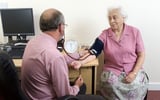 , and CT angiography should be done immediately because popliteal artery injury is possible. Next, the knee is fully examined. Active knee extension is assessed in all patients with knee pain and effusion to check for disruption of the knee extensor mechanism Knee Extensor Mechanism Injuries Knee extensor mechanism injuries can involve the quadriceps tendon, patellar tendon, patella, or tibial tubercle. Surgical repair is usually required. (See also Overview of Sprains and Other... read more
 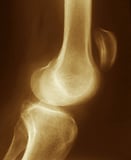 (eg, tears of the quadriceps or patellar tendon, fracture of the patella or tibial tubercle).
Bedside stress testing is done to check for specific injuries, although most of these tests are not highly accurate or reliable. For bedside stress testing, practitioners move the joint in a direction in which the ligament being tested normally prevents excessive joint movement.
For the Apley test, the patient is prone, and the examiner stabilizes the patient's thigh. The examiner flexes the patient's knee 90° and rotates the lower leg while pressing the lower leg downward toward the knee (compression), then rotates the lower leg while pulling it away from the knee (distraction). Pain during compression and rotation suggests a meniscal injury; pain during distraction and rotation suggests a ligamentous or joint capsule injury.
For evaluation of the medial and lateral collateral ligaments, the patient is supine, with the knee flexed about 20° and the hamstring muscles relaxed. The examiner puts one hand over the side of the knee opposite the ligament being tested. With the other hand, the examiner cups the heel and pulls the lower leg outward to test the medial collateral ligament or inward to test the lateral collateral ligament. Moderate instability after acute injury suggests that a meniscus or cruciate ligament is torn as well as the collateral ligament.
Not every patient requires x-rays. However, anteroposterior, lateral, and oblique x-rays are often taken to exclude fractures. The Ottawa knee rules are used to limit x-rays to patients more likely to have a fracture that requires specific treatments. X-rays should be taken only if one of the following is present:
-
Age > 55
-
Isolated tenderness of the patella (with no other bone tenderness of the knee)
-
Tenderness of fibular head
-
Inability to flex the knee 90°
-
Inability to bear weight both immediately and in the emergency department for 4 steps (with or without limping)
MRI is usually not needed at the initial evaluation. A reasonable approach is to do MRI if symptoms do not resolve after a few weeks of conservative management. However, MRI is often done when severe injury or significant intra-articular injury is suspected or cannot be otherwise excluded.
Other tests may be done to check for related injuries:
-
Arteriography or CT angiography to check for suspected arterial injuries
-
Electromyography and/or nerve conduction studies, which are rarely done immediately but more typically done when nerve symptoms persist weeks to months after the injury
-
1. Rayan F, Bhonsle S, Shukla DD: Clinical, MRI, and arthroscopic correlation in meniscal and anterior cruciate ligament injuries. Int Orthop 2009 33 (1):129–132, 2009. doi: 10.1007/s00264-008-0520-4
-
2. Benjaminse A, Gokeler A, van der Schans CP: Clinical diagnosis of an anterior cruciate ligament rupture: A meta-analysis. J Orthop Sports Phys Ther 36 (5):267–288, 2006.
-
Mild sprains: Protection, rest, ice, compression, and elevation (PRICE) with early immobilization
-
Severe injuries: Splinting or a knee immobilizer and referral to an orthopedic surgeon for surgical repair
Severe 2nd-degree and most 3rd-degree sprains require casting for ≥ 6 weeks.
Some 3rd-degree injuries of the medial collateral ligament and anterior cruciate ligament require arthroscopic surgical repair. Patients with severe injuries are referred to an orthopedic surgeon for surgical repair.
Meniscal injuries vary widely in their characteristics and treatments. Large, complex, or vertical tears and injuries that result in persistent effusions or disabling symptoms are more likely to require surgery. Patient preference can influence choice of treatment.
Physical therapy may be helpful, depending on the patient and the type of injury.
-
Stress testing (usually done days after the injury) is necessary for differentiation of partial from complete ligamentous tears and is more sensitive than MRI.
-
Consider injury to the anterior cruciate ligament and other intra-articular structures if patients have an effusion after an injury.
-
Consider knee dislocation and popliteal artery injury if patients have a large hemarthrosis, gross instability, or both.
-
If patients have knee pain and effusion, test active knee extension to check for disruption of the extensor mechanism (eg, tears of the quadriceps or patellar tendon, fracture of the patella or tibial tubercle).
-
Do MRI if symptoms do not resolve after a few weeks of conservative management or possibly when severe injury or significant intra-articular injury is suspected or cannot be otherwise excluded.
How Soon After a Mild Knee Sprain Should I Go Back to Normal Activity
Source: https://www.merckmanuals.com/professional/injuries-poisoning/sprains-and-other-soft-tissue-injuries/knee-sprains-and-meniscal-injuries
0 Response to "How Soon After a Mild Knee Sprain Should I Go Back to Normal Activity"
Post a Comment